多选题
You have an Azure Active Directory (Azure AD) tenant that syncs with an on-premises Active Directory domain.
You have an internal web app named WebApp1 that is hosted on-premises. WebApp1 uses Integrated Windows authentication.
Some users work remotely and do NOT have VPN access to the on-premises network.
You need to provide the remote users with single sign-on (SSO) access to WebApp1.
Which two features should you include in the solution? Each correct answer presents part of the solution.
NOTE: Each correct selection is worth one point.


 2022-06-28
 共214道
共214道
相关试题
多选题
Case Study 1 - Litware
Existing Environment
Azure Environment
Litware has 10 Azure subscriptions that are linked to the Litware.com tenant and five Azure subscriptions that are linked to the dev.litware.com tenant. All the subscriptions are in an Enterprise Agreement (EA).
The litware.com tenant contains a custom Azure role-based access control (Azure RBAC) role named Role1 that grants the DataActions read permission to the blobs and files in Azure Storage.
On-Premises Environment
The on-premises network of Litware contains the resources shown in the following table.

Network Environment
Litware has ExpressRoute connectivity to Azure.
Planned Changes and Requirements
Litware plans to implement the following changes:
Migrate DB1 and DB2 to Azure.
Migrate App1 to Azure virtual machines.
Migrate the external storage used by App1 to Azure Storage. Deploy the Azure virtual machines that will host App1 to Azure dedicated hosts.
Authentication and Authorization Requirements
Litware identifies the following authentication and authorization requirements:
Only users that manage the production environment by using the Azure portal must connect from a hybrid Azure AD-joined device and authenticate by using Azure Multi-Factor Authentication (MFA).
The Network Contributor built-in RBAC role must be used to grant permissions to the network administrators for all the virtual networks in all the Azure subscriptions.
To access the resources in Azure, App1 must use the managed identity of the virtual machines that will host the app. RBAC roles must be applied at the highest level possible.
Resiliency Requirements
Litware identifies the following resiliency requirements:
Once migrated to Azure, DB1 and DB2 must meet the following requirements:
Maintain availability if two availability zones in the local Azure region fail.
Fail over automatically.
Minimize I/O latency.
App1 must meet the following requirements:
Be hosted in an Azure region that supports availability zones.
Be hosted on Azure virtual machines that support automatic scaling.
Maintain availability if two availability zones in the local Azure region fail.
Security and Compliance Requirements
Litware identifies the following security and compliance requirements:
Once App1 is migrated to Azure, you must ensure that new data can be written to the app, and the modification of new and existing data is prevented for a period of three years. On-premises users and services must be able to access the Azure Storage account that will host the data in App1.
Access to the public endpoint of the Azure Storage account that will host the App1 data must be prevented.
All Azure SQL databases in the production environment must have Transparent Data Encryption (TDE) enabled.
App1 must NOT share physical hardware with other workloads.
Business Requirements
Litware identifies the following business requirements:
Minimize administrative effort. Minimize costs.
Hotspot Question
How should the migrated databases DB1 and DB2 be implemented in Azure? 
单选题
Case Study 1 - Litware
Existing Environment
Azure Environment
Litware has 10 Azure subscriptions that are linked to the Litware.com tenant and five Azure subscriptions that are linked to the dev.litware.com tenant. All the subscriptions are in an Enterprise Agreement (EA).
The litware.com tenant contains a custom Azure role-based access control (Azure RBAC) role named Role1 that grants the DataActions read permission to the blobs and files in Azure Storage.
On-Premises Environment
The on-premises network of Litware contains the resources shown in the following table.

Network Environment
Litware has ExpressRoute connectivity to Azure.
Planned Changes and Requirements
Litware plans to implement the following changes:
Migrate DB1 and DB2 to Azure.
Migrate App1 to Azure virtual machines.
Migrate the external storage used by App1 to Azure Storage. Deploy the Azure virtual machines that will host App1 to Azure dedicated hosts.
Authentication and Authorization Requirements
Litware identifies the following authentication and authorization requirements:
Only users that manage the production environment by using the Azure portal must connect from a hybrid Azure AD-joined device and authenticate by using Azure Multi-Factor Authentication (MFA).
The Network Contributor built-in RBAC role must be used to grant permissions to the network administrators for all the virtual networks in all the Azure subscriptions.
To access the resources in Azure, App1 must use the managed identity of the virtual machines that will host the app.
RBAC roles must be applied at the highest level possible.
Resiliency Requirements
Litware identifies the following resiliency requirements:
Once migrated to Azure, DB1 and DB2 must meet the following requirements:
Maintain availability if two availability zones in the local Azure region fail.
Fail over automatically.
Minimize I/O latency.
App1 must meet the following requirements:
Be hosted in an Azure region that supports availability zones.
Be hosted on Azure virtual machines that support automatic scaling.
Maintain availability if two availability zones in the local Azure region fail.
Security and Compliance Requirements
Litware identifies the following security and compliance requirements:
Once App1 is migrated to Azure, you must ensure that new data can be written to the app, and the modification of new and existing data is prevented for a period of three years. On-premises users and services must be able to access the Azure Storage account that will host the data in App1.
Access to the public endpoint of the Azure Storage account that will host the App1 data must be prevented.
All Azure SQL databases in the production environment must have Transparent Data Encryption (TDE) enabled.
App1 must NOT share physical hardware with other workloads.
Business Requirements
Litware identifies the following business requirements:
Minimize administrative effort. Minimize costs.
After you migrate App1 to Azure, you need to enforce the data modification requirements to meet the security and compliance requirements.
What should you do?
多选题
Case Study 1 - Litware
Existing Environment
Azure Environment
Litware has 10 Azure subscriptions that are linked to the Litware.com tenant and five Azure subscriptions that are linked to the dev.litware.com tenant. All the subscriptions are in an Enterprise Agreement (EA).
The litware.com tenant contains a custom Azure role-based access control (Azure RBAC) role named Role1 that grants the DataActions read permission to the blobs and files in Azure Storage.
On-Premises Environment
The on-premises network of Litware contains the resources shown in the following table.
Network Environment
Litware has ExpressRoute connectivity to Azure.
Planned Changes and Requirements
Litware plans to implement the following changes:
Migrate DB1 and DB2 to Azure.
Migrate App1 to Azure virtual machines.
Migrate the external storage used by App1 to Azure Storage. Deploy the Azure virtual machines that will host App1 to Azure dedicated hosts.
Authentication and Authorization Requirements
Litware identifies the following authentication and authorization requirements:
Only users that manage the production environment by using the Azure portal must connect from a hybrid Azure AD-joined device and authenticate by using Azure Multi-Factor Authentication (MFA).
The Network Contributor built-in RBAC role must be used to grant permissions to the network administrators for all the virtual networks in all the Azure subscriptions.
To access the resources in Azure, App1 must use the managed identity of the virtual machines that will host the app. RBAC roles must be applied at the highest level possible.
Resiliency Requirements
Litware identifies the following resiliency requirements:
Once migrated to Azure, DB1 and DB2 must meet the following requirements:
Maintain availability if two availability zones in the local Azure region fail.
Fail over automatically.
Minimize I/O latency.
App1 must meet the following requirements:
Be hosted in an Azure region that supports availability zones.
Be hosted on Azure virtual machines that support automatic scaling.
Maintain availability if two availability zones in the local Azure region fail.
Security and Compliance Requirements
Litware identifies the following security and compliance requirements:
Once App1 is migrated to Azure, you must ensure that new data can be written to the app, and the modification of new and existing data is prevented for a period of three years. On-premises users and services must be able to access the Azure Storage account that will host the data in App1.
Access to the public endpoint of the Azure Storage account that will host the App1 data must be prevented.
All Azure SQL databases in the production environment must have Transparent Data Encryption (TDE) enabled.
App1 must NOT share physical hardware with other workloads.
Business Requirements
Litware identifies the following business requirements:
Minimize administrative effort. Minimize costs.
Hotspot Question
You plan to migrate App1 to Azure.
You need to recommend a storage solution for App1 that meets the security and compliance
Requirements.
Which type of storage should you recommend, and how should you recommend configuring the storage? To answer, select the appropriate options in the answer area.
NOTE: Each correct selection is worth one point.

多选题 Case Study 2 - Fabrikam, Inc Overview Fabrikam, Inc. is an engineering company that has offices throughout Europe. The company has a main office in London and three branch offices in Amsterdam, Berlin, and Rome. Existing Environment: Active Directory Environment The network contains two Active Directory forests named corp.fabrikam.com and rd.fabrikam.com. There are no trust relationships between the forests. Corp.fabrikam.com is a production forest that contains identities used for internal user and computer authentication. Rd.fabrikam.com is used by the research and development (R&D) department only. The R&D department is restricted to using on-premises resources only. Existing Environment: Network Infrastructure Each office contains at least one domain controller from the corp.fabrikam.com domain. The main office contains all the domain controllers for the rd.fabrikam.com forest. All the offices have a high-speed connection to the internet. An existing application named WebApp1 is hosted in the data center of the London office. WebApp1 is used by customers to place and track orders. WebApp1 has a web tier that uses Microsoft Internet information Services (IIS) and a database tier that runs Microsoft SQL Server 2016. The web tier and the database tier are deployed to virtual machines that run on Hyper-V. The IT department currently uses a separate Hyper-V environment to test updates to WebApp1. Fabrikam purchases all Microsoft licenses through a Microsoft Enterprise Agreement that includes Software Assurance. Existing Environment: Problem Statements The use of WebApp1 is unpredictable. At peak times, users often report delays. At other times, many resources for WebApp1 are underutilized. Requirements: Planned Changes Fabrikam plans to move most of its production workloads to Azure during the next few years, including virtual machines that rely on Active Directory for authentication. As one of its first projects, the company plans to establish a hybrid identity model, facilitating an upcoming Microsoft 365 deployment. All R&D operations will remain on-premises. Fabrikam plans to migrate the production and test instances of WebApp1 to Azure. Requirements: Technical Requirements Fabrikam identifies the following technical requirements: Website content must be easily updated from a single point. User input must be minimized when provisioning new web app instances. Whenever possible, existing on-premises licenses must be used to reduce cost. Users must always authenticate by using their corp.fabrikam.com UPN identity. Any new deployments to Azure must be redundant in case an Azure region fails. Whenever possible, solutions must be deployed to Azure by using the Standard pricing tier of Azure App Service. An email distribution group named IT Support must be notified of any issues relating to the directory synchronization services. In the event that a link fails between Azure and the on-premises network, ensure that the virtual machines hosted in Azure can authenticate to Active Directory. Directory synchronization between Azure Active Directory (Azure AD) and corp.fabrikam.com must not be affected by a link failure between Azure and the on-premises network. Requirements: Database Requirements Fabrikam identifies the following database requirements: Database metrics for the production instance of WebApp1 must be available for analysis so that database administrators can optimize the performance settings. To avoid disrupting customer access, database downtime must be minimized when databases are migrated. Database backups must be retained for a minimum of seven years to meet compliance requirements. Requirements: Security Requirements Fabrikam identifies the following security requirements: Company information including policies, templates, and data must be inaccessible to anyone outside the company. Users on the on-premises network must be able to authenticate to corp.fabrikam.com if an internet link fails. Administrators must be able authenticate to the Azure portal by using their corp.fabrikam.com credentials. All administrative access to the Azure portal must be secured by using multi-factor authentication (MFA). The testing of WebApp1 updates must not be visible to anyone outside the company. Hotspot Question You are evaluating the components of the migration to Azure that require you to provision an Azure Storage account. For each of the following statements, select Yes if the statement is true. Otherwise, select No. NOTE: Each correct selection is worth one point.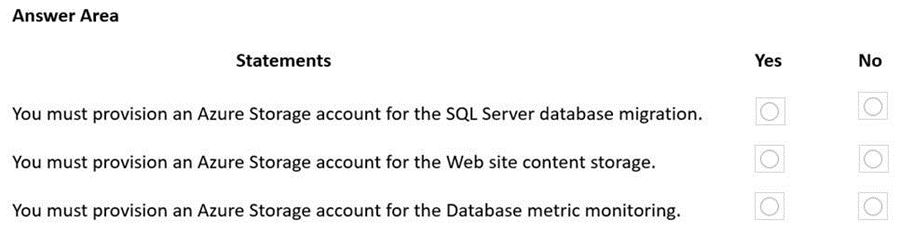
单选题 Case Study 1 - Litware Existing Environment Azure Environment Litware has 10 Azure subscriptions that are linked to the Litware.com tenant and five Azure subscriptions that are linked to the dev.litware.com tenant. All the subscriptions are in an Enterprise Agreement (EA). The litware.com tenant contains a custom Azure role-based access control (Azure RBAC) role named Role1 that grants the DataActions read permission to the blobs and files in Azure Storage. On-Premises Environment The on-premises network of Litware contains the resources shown in the following table. Network Environment Litware has ExpressRoute connectivity to Azure. Planned Changes and Requirements Litware plans to implement the following changes: Migrate DB1 and DB2 to Azure. Migrate App1 to Azure virtual machines. Migrate the external storage used by App1 to Azure Storage. Deploy the Azure virtual machines that will host App1 to Azure dedicated hosts. Authentication and Authorization Requirements Litware identifies the following authentication and authorization requirements: Only users that manage the production environment by using the Azure portal must connect from a hybrid Azure AD-joined device and authenticate by using Azure Multi-Factor Authentication (MFA). The Network Contributor built-in RBAC role must be used to grant permissions to the network administrators for all the virtual networks in all the Azure subscriptions. To access the resources in Azure, App1 must use the managed identity of the virtual machines that will host the app. RBAC roles must be applied at the highest level possible. Resiliency Requirements Litware identifies the following resiliency requirements: Once migrated to Azure, DB1 and DB2 must meet the following requirements: Maintain availability if two availability zones in the local Azure region fail. Fail over automatically. Minimize I/O latency. App1 must meet the following requirements: Be hosted in an Azure region that supports availability zones. Be hosted on Azure virtual machines that support automatic scaling. Maintain availability if two availability zones in the local Azure region fail. Security and Compliance Requirements Litware identifies the following security and compliance requirements: Once App1 is migrated to Azure, you must ensure that new data can be written to the app, and the modification of new and existing data is prevented for a period of three years. On-premises users and services must be able to access the Azure Storage account that will host the data in App1. Access to the public endpoint of the Azure Storage account that will host the App1 data must be prevented. All Azure SQL databases in the production environment must have Transparent Data Encryption (TDE) enabled. App1 must NOT share physical hardware with other workloads. Business Requirements Litware identifies the following business requirements: Minimize administrative effort. Minimize costs. You plan to migrate App1 to Azure. You need to recommend a network connectivity solution for the Azure Storage account that will host the App1 data. The solution must meet the security and compliance requirements. What should you include in the recommendation?
单选题 Case Study 1 - Litware Existing Environment Azure Environment Litware has 10 Azure subscriptions that are linked to the Litware.com tenant and five Azure subscriptions that are linked to the dev.litware.com tenant. All the subscriptions are in an Enterprise Agreement (EA). The litware.com tenant contains a custom Azure role-based access control (Azure RBAC) role named Role1 that grants the DataActions read permission to the blobs and files in Azure Storage. On-Premises Environment The on-premises network of Litware contains the resources shown in the following table. Network Environment Litware has ExpressRoute connectivity to Azure. Planned Changes and Requirements Litware plans to implement the following changes: Migrate DB1 and DB2 to Azure. Migrate App1 to Azure virtual machines. Migrate the external storage used by App1 to Azure Storage. Deploy the Azure virtual machines that will host App1 to Azure dedicated hosts. Authentication and Authorization Requirements Litware identifies the following authentication and authorization requirements: Only users that manage the production environment by using the Azure portal must connect From a hybrid Azure AD-joined device and authenticate by using Azure Multi-Factor Authentication (MFA). The Network Contributor built-in RBAC role must be used to grant permissions to the network administrators for all the virtual networks in all the Azure subscriptions. To access the resources in Azure, App1 must use the managed identity of the virtual machines that will host the app. RBAC roles must be applied at the highest level possible. Resiliency Requirements Litware identifies the following resiliency requirements: Once migrated to Azure, DB1 and DB2 must meet the following requirements: Maintain availability if two availability zones in the local Azure region fail. Fail over automatically. Minimize I/O latency. App1 must meet the following requirements: Be hosted in an Azure region that supports availability zones. Be hosted on Azure virtual machines that support automatic scaling. Maintain availability if two availability zones in the local Azure region fail. Security and Compliance Requirements Litware identifies the following security and compliance requirements: Once App1 is migrated to Azure, you must ensure that new data can be written to the app, and the modification of new and existing data is prevented for a period of three years. On-premises users and services must be able to access the Azure Storage account that will host the data in App1. Access to the public endpoint of the Azure Storage account that will host the App1 data must be prevented. All Azure SQL databases in the production environment must have Transparent Data Encryption (TDE) enabled. App1 must NOT share physical hardware with other workloads. Business Requirements Litware identifies the following business requirements: Minimize administrative effort. Minimize costs. You need to implement the Azure RBAC role assignments for the Network Contributor role. The solution must meet the authentication and authorization requirements. What is the minimum number of assignments that you must use?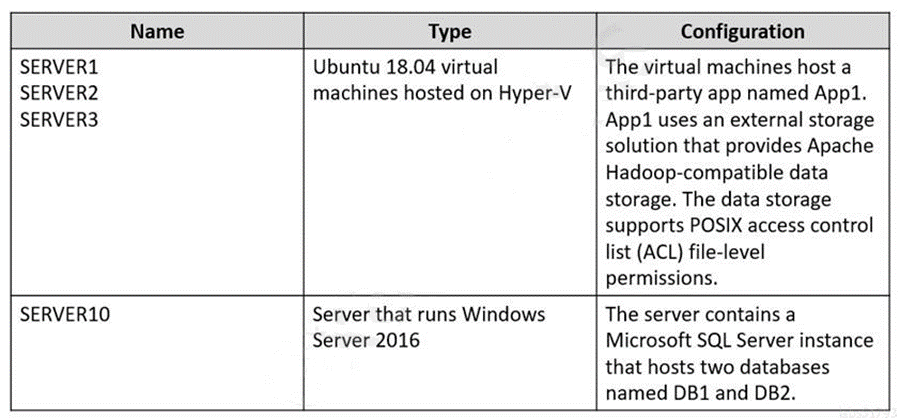
单选题 Case Study 2 - Fabrikam, Inc Overview Fabrikam, Inc. is an engineering company that has offices throughout Europe. The company has a main office in London and three branch offices in Amsterdam, Berlin, and Rome. Existing Environment: Active Directory Environment The network contains two Active Directory forests named corp.fabrikam.com and rd.fabrikam.com. There are no trust relationships between the forests. Corp.fabrikam.com is a production forest that contains identities used for internal user and computer authentication. Rd.fabrikam.com is used by the research and development (R&D) department only. The R&D department is restricted to using on-premises resources only. Existing Environment: Network Infrastructure Each office contains at least one domain controller from the corp.fabrikam.com domain. The main office contains all the domain controllers for the rd.fabrikam.com forest. All the offices have a high-speed connection to the internet. An existing application named WebApp1 is hosted in the data center of the London office. WebApp1 is used by customers to place and track orders. WebApp1 has a web tier that uses Microsoft Internet information Services (IIS) and a database tier that runs Microsoft SQL Server 2016. The web tier and the database tier are deployed to virtual machines that run on Hyper-V. The IT department currently uses a separate Hyper-V environment to test updates to WebApp1. Fabrikam purchases all Microsoft licenses through a Microsoft Enterprise Agreement that includes Software Assurance. Existing Environment: Problem Statements The use of WebApp1 is unpredictable. At peak times, users often report delays. At other times, many resources for WebApp1 are underutilized. Requirements: Planned Changes Fabrikam plans to move most of its production workloads to Azure during the next few years, including virtual machines that rely on Active Directory for authentication. As one of its first projects, the company plans to establish a hybrid identity model, facilitating an upcoming Microsoft 365 deployment. All R&D operations will remain on-premises. Fabrikam plans to migrate the production and test instances of WebApp1 to Azure. Requirements: Technical Requirements Fabrikam identifies the following technical requirements: Website content must be easily updated from a single point. User input must be minimized when provisioning new web app instances. Whenever possible, existing on-premises licenses must be used to reduce cost. Users must always authenticate by using their corp.fabrikam.com UPN identity. Any new deployments to Azure must be redundant in case an Azure region fails. Whenever possible, solutions must be deployed to Azure by using the Standard pricing tier of Azure App Service. An email distribution group named IT Support must be notified of any issues relating to the directory synchronization services. In the event that a link fails between Azure and the on-premises network, ensure that the virtual machines hosted in Azure can authenticate to Active Directory. Directory synchronization between Azure Active Directory (Azure AD) and corp.fabrikam.com must not be affected by a link failure between Azure and the on-premises network. Requirements: Database Requirements Fabrikam identifies the following database requirements: Database metrics for the production instance of WebApp1 must be available for analysis so that database administrators can optimize the performance settings. To avoid disrupting customer access, database downtime must be minimized when databases are migrated. Database backups must be retained for a minimum of seven years to meet compliance requirements. Requirements: Security Requirements Fabrikam identifies the following security requirements: Company information including policies, templates, and data must be inaccessible to anyone outside the company. Users on the on-premises network must be able to authenticate to corp.fabrikam.com if an internet link fails. Administrators must be able authenticate to the Azure portal by using their corp.fabrikam.com credentials. All administrative access to the Azure portal must be secured by using multi-factor authentication (MFA). The testing of WebApp1 updates must not be visible to anyone outside the company. What should you include in the identity management strategy to support the planned changes?
单选题 Case Study 2 - Fabrikam, Inc Overview Fabrikam, Inc. is an engineering company that has offices throughout Europe. The company has a main office in London and three branch offices in Amsterdam, Berlin, and Rome. Existing Environment: Active Directory Environment The network contains two Active Directory forests named corp.fabrikam.com and rd.fabrikam.com. There are no trust relationships between the forests. Corp.fabrikam.com is a production forest that contains identities used for internal user and computer authentication. Rd.fabrikam.com is used by the research and development (R&D) department only. The R&D department is restricted to using on-premises resources only. Existing Environment: Network Infrastructure Each office contains at least one domain controller from the corp.fabrikam.com domain. The main office contains all the domain controllers for the rd.fabrikam.com forest. All the offices have a high-speed connection to the internet. An existing application named WebApp1 is hosted in the data center of the London office. WebApp1 is used by customers to place and track orders. WebApp1 has a web tier that uses Microsoft Internet information Services (IIS) and a database tier that runs Microsoft SQL Server 2016. The web tier and the database tier are deployed to virtual machines that run on Hyper-V. The IT department currently uses a separate Hyper-V environment to test updates to WebApp1. Fabrikam purchases all Microsoft licenses through a Microsoft Enterprise Agreement that includes Software Assurance. Existing Environment: Problem Statements The use of WebApp1 is unpredictable. At peak times, users often report delays. At other times, many resources for WebApp1 are underutilized. Requirements: Planned Changes Fabrikam plans to move most of its production workloads to Azure during the next few years, including virtual machines that rely on Active Directory for authentication. As one of its first projects, the company plans to establish a hybrid identity model, facilitating an upcoming Microsoft 365 deployment. All R&D operations will remain on-premises. Fabrikam plans to migrate the production and test instances of WebApp1 to Azure. Requirements: Technical Requirements Fabrikam identifies the following technical requirements: Website content must be easily updated from a single point. User input must be minimized when provisioning new web app instances. Whenever possible, existing on-premises licenses must be used to reduce cost. Users must always authenticate by using their corp.fabrikam.com UPN identity. Any new deployments to Azure must be redundant in case an Azure region fails. Whenever possible, solutions must be deployed to Azure by using the Standard pricing tier of Azure App Service. An email distribution group named IT Support must be notified of any issues relating to the directory synchronization services. In the event that a link fails between Azure and the on-premises network, ensure that the virtual machines hosted in Azure can authenticate to Active Directory. Directory synchronization between Azure Active Directory (Azure AD) and corp.fabrikam.com must not be affected by a link failure between Azure and the on-premises network. Requirements: Database Requirements Fabrikam identifies the following database requirements: Database metrics for the production instance of WebApp1 must be available for analysis so that database administrators can optimize the performance settings. To avoid disrupting customer access, database downtime must be minimized when databases are migrated. Database backups must be retained for a minimum of seven years to meet compliance requirements. Requirements: Security Requirements Fabrikam identifies the following security requirements: Company information including policies, templates, and data must be inaccessible to anyone outside the company. Users on the on-premises network must be able to authenticate to corp.fabrikam.com if an internet link fails. Administrators must be able authenticate to the Azure portal by using their corp.fabrikam.com credentials. All administrative access to the Azure portal must be secured by using multi-factor authentication (MFA). The testing of WebApp1 updates must not be visible to anyone outside the company. You need to recommend a solution to meet the database retention requirements. What should you recommend?